When visiting a major city, there are many things to do and interesting people. But in car-centric cities, finding parking can be a hassle. And paying for parking, much less getting a parking ticket is even worse.
If I were to visit a neighboring city on vacation, how can I strategize to avoid a parking ticket?
Sub Questions:
What time of day am I most likely to get a ticket?
What is the most common violation, and where does it occur?
Is there a specific Month or Weekday I am less likely to get a ticket?
Overview
Data sourced from DOT in Montgomery, Maryland. Link: Data.gov
150,000+ rows of data, SQL is best use for this volume
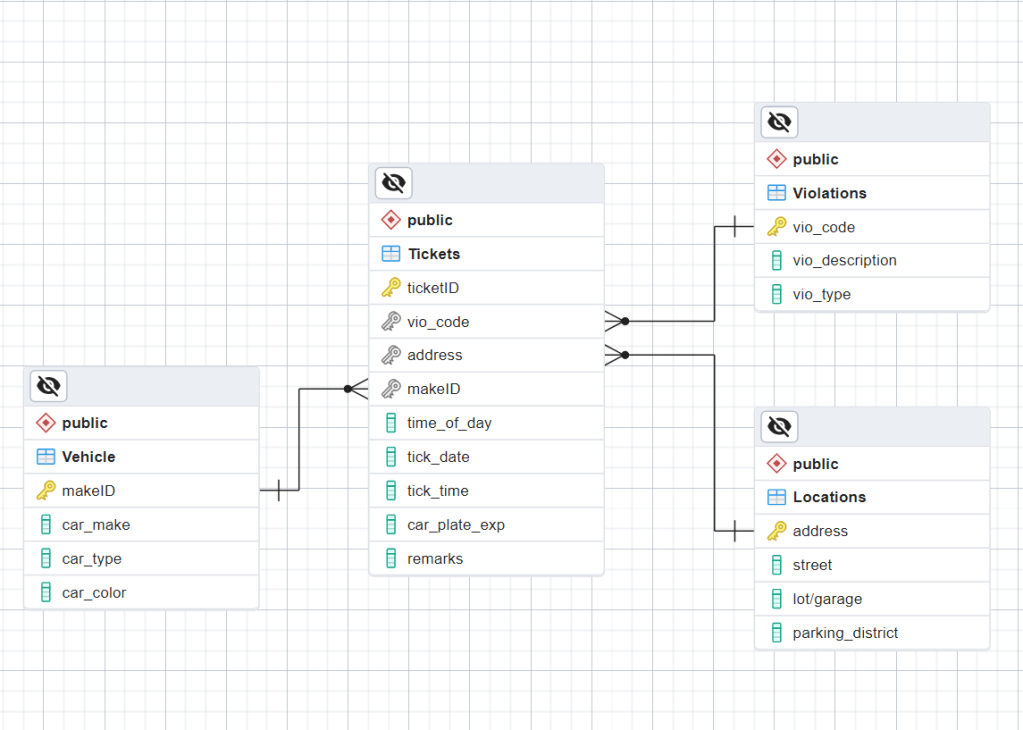
Designed ERD to ensure Entity and Relationship Integrity
Processed Raw Data (cleaned addresses, classified violations, etc…)
See Cleaning Strategy for details
Loaded cleaned data into schema design
Main Tables: Tickets, Violations, Locations, and Vehicle
ERD done in PostGres Admin
Results
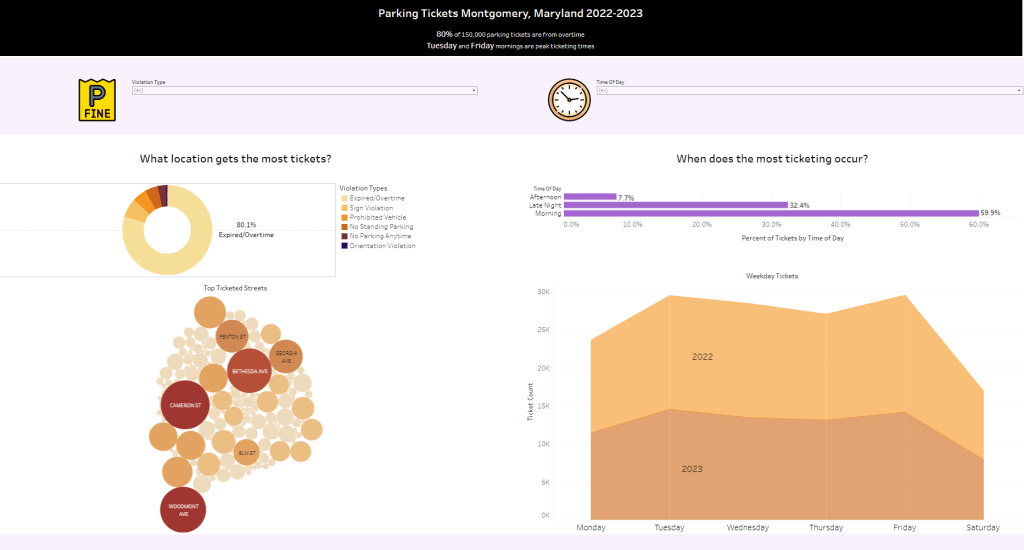
Click here to see interactive dashboard. See my Github to view all SQL used.
Recommendations for avoiding tickets:
80% of tickets are expired parking. Be punctual, or pay for extra time.
If you are neither punctual or have deep pockets, park away from areas with lots of activity. Locations near malls and food hotspots such as Woodmont Ave. ,Cameron St., and Bethesda make up more than 20% of ticketing locations
Take advantage of “weekend slumps”. Visit and park on Monday or Saturdays when workers are less active
Morning is the most risky time to park, and should be avoided. There is a skew in the data collection. No tickets occurred from 6pm-12am. This could show a gap in DOT staffing.
More on Cleaning Strategy
Remove Duplicate and Null Rows
Use window function to create unique vehicle MakeID, to reduce redundancy
Clean Ticket Locations by splitting into address, street, and lot #
Replaced redundant false-null lot # for addresses that had both null and non-null values
Classify time of ticketing to time of day: Morning, Afternoon, Night, and Late Night
Condense Parking Violation Types (From 41 similar types, down to 7 distinct)
2) Window function to create MakeID for vehicles table
This file contains hidden or bidirectional Unicode text that may be interpreted or compiled differently than what appears below. To review, open the file in an editor that reveals hidden Unicode characters.
Learn more about bidirectional Unicode characters
This file contains hidden or bidirectional Unicode text that may be interpreted or compiled differently than what appears below. To review, open the file in an editor that reveals hidden Unicode characters.
Learn more about bidirectional Unicode characters
4) Clean Locations Table – filtered addresses that had both null/non-null lots
This file contains hidden or bidirectional Unicode text that may be interpreted or compiled differently than what appears below. To review, open the file in an editor that reveals hidden Unicode characters.
Learn more about bidirectional Unicode characters
This file contains hidden or bidirectional Unicode text that may be interpreted or compiled differently than what appears below. To review, open the file in an editor that reveals hidden Unicode characters.
Learn more about bidirectional Unicode characters
Originally there were 41 classifications of violations. But many types were self-similar. For example, ‘off street’ and ‘on street’ are of the same overtime parking violation.
This file contains hidden or bidirectional Unicode text that may be interpreted or compiled differently than what appears below. To review, open the file in an editor that reveals hidden Unicode characters.
Learn more about bidirectional Unicode characters
— Condense 41 violation codes into 7, called vio_type
UPDATE "DOTclean"
SET vio_code = temp."Violation Code",
vio_description = temp."Violation Description",
vio_type = temp."violation_type"
FROM (
Select "Ticket Number",
"Violation Code",
"Violation Description",
CASE
When "Violation Code" = 10 or "Violation Code" = 12 or "Violation Code" = 17 or "Violation Code" = 22 or "Violation Code" = 22 or "Violation Code" = 23 or "Violation Code" = 25 or "Violation Code" = 31 or "Violation Code" = 32 or "Violation Code" = 57 or "Violation Code" = 11 or "Violation Code" = 18 Then 'No Standing Parking'
When "Violation Code" = 3 or "Violation Code" = 5 or "Violation Code" = 34 or "Violation Code" = 37 Then 'No Parking Anytime'
When "Violation Code" = 7 or "Violation Code" = 41 or "Violation Code" = 50 Then 'Expired/Overtime'
When "Violation Code" = 9 or "Violation Code" = 35 or "Violation Code" = 36 or "Violation Code" = 43 or "Violation Code" = 54 or "Violation Code" = 1 or "Violation Code" = 47 or "Violation Code" = 55 Then 'Sign Violation or Impeding Traffic'
When "Violation Code" = 2 or "Violation Code" = 38 or "Violation Code" = 42 or "Violation Code" = 48 or "Violation Code" = 39 or "Violation Code" = 40 or "Violation Code" = 46 or "Violation Code" = 56 Then 'Prohibited Vehicle'
When "Violation Code" = 8 or "Violation Code" = 19 or "Violation Code" = 20 or "Violation Code" = 24 or "Violation Code" = 27 or "Violation Code" = 28 or "Violation Code" = 59 or "Violation Code" = 45 or "Violation Code" = 4 Then 'Orientation Violation'
 data-boon.com